


Exercise after birth

Exercise and training after birth
In this blog post you can be inspired on how to approach training after giving birth. After pregnancy and giving birth, the body needs the right rehabilitation to come back strong again. It is a time when you cannot and must not do much. The body needs to be given time to heal, and we need to be patient. But at the same time, it is wise not to just do nothing but prioritizes the simple, calm (and to some extent boring) rehabilitation of the core and pelvis. In this way, we can help the body become strong and functional again.

Postpartum rehabilitation - My experience
Before we dive into all the knowledge I want to impart, I want to share my own experience. I was active throughout my pregnancy and really enjoyed it. I was able to run until week 32 and continued to do bodyweight exercises and walk until the birth. I think that gave me a good starting point because my fitness and strength hadn't completely disappeared during pregnancy. At the same time, I was also surprised by how little my body was capable of after the birth and what it took to retrain it again.
TIP: Also try one pregnancy-friendly arm and butt workout or a in-depth posts about training while pregnant as well as a training video
Mine (or Otto's) ♥) birth was long and hard, as you can read in my birth report here. I ended up with a second-degree tear and a abdomen that felt like it was being torn apart, to say the least, due to a very long pushing phase. This meant that I could hardly walk for the first week after the birth. It hurt when I was upright, and I limped slowly. The hospital staff recommended that I start doing abdominal exercises the day after the birth. But at first I didn't take it seriously at all. I had no contact with my lower abdomen and thought they had misunderstood something: I couldn't squeeze at all?! So a week passed before I started giving it a try. A gynecologist explained to me that the squeezing exercises were important because they brought more blood circulation to the area and thus helped the rupture heal. And that was also the experience I had as soon as I started. It was only when I started squeezing that the pain in my lower abdomen began to disappear. I slowly got in touch with the muscles. I also started to lie down on my stomach after I had done my squeezing exercises, to help the uterus empty of blood, and I also experienced that having a good effect.
The first month after birth
The first month I did squat exercises for maybe 15 minutes spread out throughout the day. At first lying on my back, and often when I was breastfeeding and remembered it. As I got used to it, I practiced maintaining the squat when I put my feet on the floor and lifted my pelvis, and I also tried to squat while standing and walking. A week after the birth I started going for walks with the stroller. At first it was very short and very slow walks, because I got pain if I stood up for too long. But I tried to walk and stand for short periods during the day, again to get the blood circulation going. For the same reason, I also did venous pump exercises with my legs, to get blood around the body.
Second month after birth
After a month the pain was gone and I started going for longer walks of an hour or more. I still did crunches daily and also started doing very simple yoga exercises. Good stretches and gentle flows, mostly just because I thought it was nice and because it felt like a breather.My abdominal muscles were still very divided here, so I was careful to avoid any strain on that area.
After 8 weeks
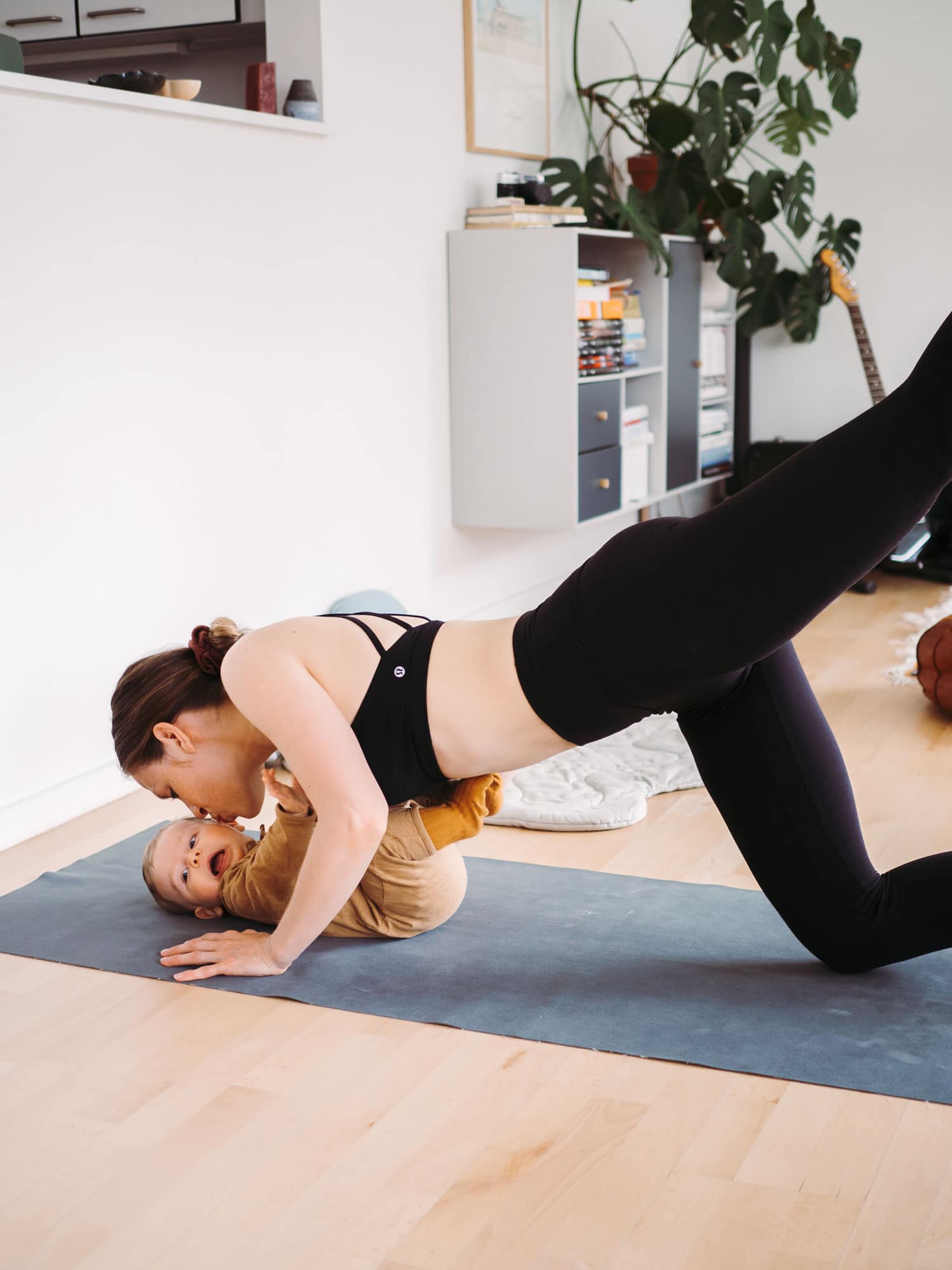
After 8 weeks I went to the doctor for a check-up, and here I got the green light to start exercising again. I therefore started doing mama training (mother/child training) at YO Studios, where I got a light sweat on my forehead a couple of times a week. We did exercises focusing on the pelvis and core - while Otto lay and watched on a play mat. I had been looking forward to being able to start running again and therefore also started to do short runs. At first only 3 kilometers, where I walked more than I ran. And I really saw it as one long squat exercise. Every time I ran, I focused on having contact with the abdomen and core and sucking in and up. Slowly I was able to increase the distance and pace, as I knew that I could maintain the contact. At this time, I also started to have a greater focus on my split abdominal muscles. I did breathing and core exercises (find more inspiration for exercises further down in the blog post) and focused on maintaining strength in my pelvis, as I slowly increased the intensity week by week. At the same time, I focused on doing exercises for my back and arms (often with an elastic band), to do something good for the sore mother muscles from breastfeeding and "carrying around".
Today - 5 months after birth
Today Otto is exactly 5 months old, and my body is starting to feel like itself again after giving birth. I feel strong and healthy. I can run and jump without wetting my pants. I can go for long walks with Otto in a swaddle and carry him around for hours. But my training still doesn't look like it did before I got pregnant. And it will probably be another six months before I don't have to/want to take special care when I move. First of all, I don't move as long or often as I used to. Because... Otto, haha! But I still prioritize moving in one way or another most days. Whether it's 15 minutes of pilates, a short yoga flow (while Otto lies and rolls around on the play mat) or a brisk walk on the days when nothing else can be done. The training itself is calmer and more controlled because I have a big focus on my core. My abdominal muscles are almost completely contracted with about 1-1.5 finger widths between them. But to ensure that the muscles contract further, I prioritize doing breathing and crunch exercises over regular abdominal exercises. I only do planks for short periods of time (with a big focus on squeezing and sucking my belly button in and out), and avoid exercises like crunches. There is no specific goal with my training. At least nothing other than that I should feel good and stay strong and healthy. So I am not in a hurry to run a half marathon or get a six-pack. I am just happy and proud that my body can already do so much... Yes, it is a huge cliché, but the female body is so cool!
TIP: Also listen to the podcast episode Postpartum training with Emma Kaalund


Postpartum training with Malene Arvin
To help us understand how best to retrain our bodies after pregnancy and childbirth, I have been helped by Malene Arvin. She is the woman behind YO Studios, where I have gone for pregnancy and mama training. Malene can take a large part of the credit for the joy of movement that I experience in my everyday life. Throughout my pregnancy and postpartum, Malene has been my guru, whom I have listened to in relation to training and movement. She is currently pregnant with her third child, and she has extensive experience in teaching both pregnant women and postpartum training. 
When should you start exercising after giving birth?
The day after birth, you should start pelvic floor training.It can only be too slow to reactivate and create good contact with your pelvis and lower abdomen again. Fortunately, there is plenty of opportunity and time for this, because glute exercises can be done at any time and in most situations. When you have had your 8-week check-up, have received the OK from the doctor and otherwise feel ready, you can safely begin the 'rehabilitation'. Here it is extremely important to have respect for the fact that the body should be treated with tenderness and patience, when movement and training are initiated again. Impatience and progressing too quickly and hard will have really painful and perhaps even lasting consequences in the future. I would go so far as to call it 'mole work' to be too busy. You will most likely have to start almost from scratch to correct the damage, and this will almost certainly prolong the process towards normal conditions and a well-functioning body significantly.
TIP: Try this simple Pilates home workout when you're ready to move again.

Split abdominal muscles: Rectus diastasis
Rectus diastasis occurs when the abdominal muscles divide to make room for the baby growing in the abdomen. Here, the Linea Alba, which runs down the midline from the sternum to the pubic bone, and to which the abdominal muscles attach, stretches and pulls out to the sides as the abdomen grows. This is normal and will happen to all pregnant women. But it is actually not only pregnant women and postpartum women who experience rectus diastasis. It is also seen in other cases, such as in apparently 'well-trained' people who have trained with the wrong technique and over a long period of time. As a result, they have strained the core muscles 'incorrectly'. It can also happen to severely obese people, where the abdominal muscles divide due to increased strain 'from within'.
What is diastasis recti?
Rectus diastasis is typically measured in finger widths. If you have more than 2 finger widths of space between your abdominal muscles, you have rectus diastasis. After pregnancy, the goal is to get down to 1-1.5 finger widths.
If the abdominal muscles do not spontaneously contract by about 8 weeks after birth, it will NOT happen by itself. You must therefore work on the matter in an appropriate and correct way with your postnatal training. Here it is highly recommended that you seek knowledge and advice from someone who knows something about rectus diastasis, and possibly sign up for a class/course that will help you get started.
Check if you have split abs
1. Lie on your back and bend your knees so that your feet come all the way up under your buttocks. 2. Place the fingertips of one hand into your stomach above your navel, so that your fingers are horizontal on your stomach with your thumb and little finger pointing out towards each side of your waist. 3. Lift your head off the floor, while keeping your shoulders on the floor. 4. Gently press your fingers into your stomach and feel how many fingers can be in the soft area between the abdominal muscles.
Why should you take diastasis recti seriously?
Abs and core can be largely functional despite slightly separated abs. Even if you have rectus diastasis you can do almost anything you want, which is why MANY people don't take the work of getting their abs back together seriously. However, the long-term consequences can be quite painful. Cosmetic You will most likely always have the feeling of a small 'top belly', regardless of how you otherwise look. The ability to activate the abdominal muscles will be bad because it is more difficult or perhaps impossible without union on the rectus diastasis. Incontinence, So, to put it bluntly, peeing in the ass is completely normal with a weak core, because the pelvic floor is a central part of the core muscles. The same goes for sluggish digestion and general toilet problems. Back and lower back pain can either occur quite quickly or can be difficult to avoid later in life. And then there are the consequences that almost certainly require treatment/surgery - including, among other things umbilical hernia and a real rip-off of the linea alba fascia (the connective tissue strip to which the abdominal muscles attach). 
How do you retrain your body after pregnancy and childbirth?
For your postpartum workout, you should focus on core training, where the WHOLE core is involved. It is important that you avoid incorrect strain on the rectus diastasis (the divided abdominal muscles). Incorrect and stressful training is the vast majority of well-known abdominal exercises such as crunches, planks and heavy lifting, but also sitting up directly from a lying position without rolling over on your side first. Focusing on an active core is at least as important in everyday situations - for example when you lift your child!
How to tighten your abs again
1. Learn to activate your core properly. 2. Protect the weak connective tissue - even in everyday situations. 3. Do specific exercises to strengthen your core
What is the core?
It is important to have a good sense of what the core actually consists of. Especially after pregnancy and childbirth - but also in general. Core training is mentioned interchangeably, but what is the core actually? You need to know this for your postpartum training. The core consists of an area that covers almost your entire torso. These are your muscles in the thighs, buttocks, pelvic floor, abdominal and waist region on both the front and back and further up to your chest and upper back muscles. Having a strong core therefore means that you are able to activate the entire area. That is, the entire core together with your breathing in a controlled and good way. After childbirth, you will most likely have a rectus diastasis, divided abdominal muscles. This contributes to the core not being able to function optimally, which is completely natural. Therefore, you need to start creating good contact with your core again with planned exercises that take into account the rectus diastasis and do not strain it, as this will worsen the situation. Furthermore, you have to remember that as much as you strengthen and tense your core, you have to relax and unwind that area just as much. So don't tense up all the time and never allow your body to become completely lazy again. You HAVE to prioritize and remember that too!
Get a grip on your core
1. Start by restoring good contact and strength in the pelvic floor with squat exercises where you use your breath. 2. Let the pelvic floor and squat exercises spread further up and 'propagate' into the rest of the core muscles without straining the rectus diastasis. This is done, for example, with lying exercises that activate the pelvic floor, thighs and buttocks as well as the entire abdominal and back muscles at once. Again, it is important to emphasize that you must learn to use your breath. The respiratory muscles are an important player in a strong and effective core! 3. When you can keep an active and strong core in a lying movement, you can continue to larger exercises that activate more of the body, such as standing exercises. It is a super good idea, to be quite fanatical about core tension here, so that before each repetition you 'check in' on the tension, and make sure that it is still there. 4. When the abdominal muscles have contracted, you can resume normal training with everything that entails.But of course with an eternally strong core, which you may have been used to using in training earlier in life before pregnancy and childbirth, or perhaps have discovered as a newfound strength that will last throughout your life. 
The goal of postpartum exercise
If you strain the divided abdominal muscles with the wrong training, you will slow down and worsen the situation. Unfortunately, I have experienced many who have never been able to bring their abdominal muscles back together again because they did not take the rectus diastasis seriously. However, with the correct training, you can speed up the process and move towards a state where you can do everything you could before again - and maybe even more! It is of course completely individual to what extent you value and prioritize a strong body. But I would almost dare to say that no one thinks it is cool to have chronic pain or, for example, 'shatpis' in your panties every time you jump or sneeze. A strong core has so many advantages, the least important of which in my opinion is the 'cosmetic' one. It is completely irrelevant how you look if it does not reflect how you feel. But a healthy attitude, a well-functioning 'inner' system and generally the feeling of being capable of the things you want - few people can disagree that this is a desirable state.
"I just want to emphasize how important proper postpartum rehabilitation is! With two births under my belt (and one in the near future), as well as many years of experience with training pregnant and postpartum women, I have experienced firsthand and seen in others how incredibly positive results can be achieved with the right effort. And conversely - how the most negative consequences can take root and reduce the quality of life of many otherwise cool mothers. It is not for superwomen or especially 'chosen' to achieve a strong body and core. It just requires the right work, and everyone can get there." - Malene Arvin
Postpartum workout videos
These videos from YO Studios are great for training both during and after pregnancy. The focus is on strengthening the pelvic floor and connecting to the entire core.